 |
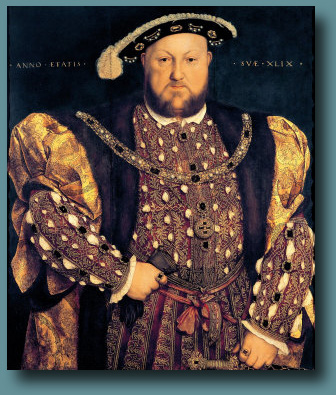
The term "Renaissance" is from
the same French word, meaning "rebirth." It comes from the Italian
Rinascimento, "Re" meaning "again" and "nascere" meaning
"be born." The Renaissance was a cultural movement that spanned roughly
the 14th to the 17th century, beginning in Italy in the Late Middle Ages
and later spreading to the rest of Europe. Its influence affected
literature, philosophy, art, politics, science, religion, and other
aspects of intellectual enquiry.
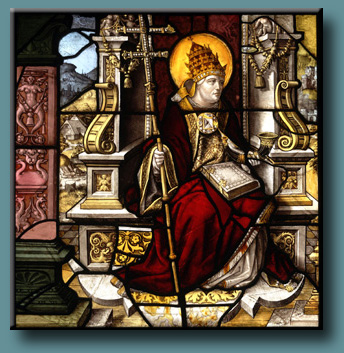
German Stained glass, from the
cloister of Mariawald Abbey, Saint Cornelius, about 1520 - 1521
|
|
  As
a cultural movement, the Renaissance period encompassed a rebellion of
classical-based learning, the development of linear perspective in
painting, and gradual but widespread educational reform. Traditionally,
this intellectual transformation has resulted in the Renaissance being
viewed as a bridge between the Middle Ages and the Modern era. Although
the Renaissance saw revolutions in many intellectual pursuits, as well
as social and political upheaval, it is perhaps best known for its
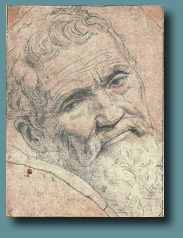
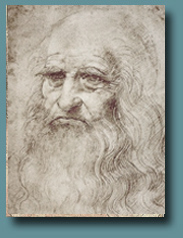
artistic developments and the contributions of such
polymaths as
Leonardo da Vinci and
Michelangelo, who inspired the term "Renaissance man". As
a cultural movement, the Renaissance period encompassed a rebellion of
classical-based learning, the development of linear perspective in
painting, and gradual but widespread educational reform. Traditionally,
this intellectual transformation has resulted in the Renaissance being
viewed as a bridge between the Middle Ages and the Modern era. Although
the Renaissance saw revolutions in many intellectual pursuits, as well
as social and political upheaval, it is perhaps best known for its
artistic developments and the contributions of such
polymaths as
Leonardo da Vinci and
Michelangelo, who inspired the term "Renaissance man".
Michelangelo di Lodovico Buonarroti Simoni
Leonardo da Vinci
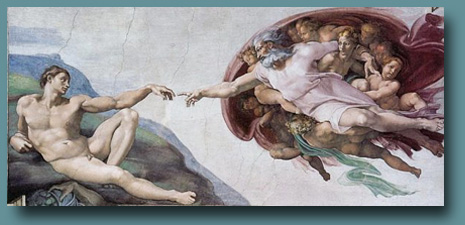
The Creation of Adam by Michelangelo,
Sistine Chapel ceiling
 |
|
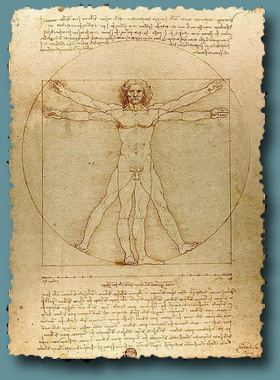
Da Vinci's
Vitruvian Man
clearly shows the effect writers of antiquity had on Renaissance thinkers.
Based on the specifications in
Vitruvius's De Architectura, da Vinci tried
to draw the perfectly proportioned man. |
 |
Origin
There is a general, but not
unchallenged, consensus that the Renaissance began in
Tuscany in the 14th
century. Various theories have been proposed to account for its origins
and characteristics, focusing on a variety of factors including the social
and civic peculiarities of Florence at the time; its political structure;
the patronage of its dominant family, the Medici; and the migration of
Greek scholars and texts to Italy following the Fall of Constantinople at
the hands of the Ottoman Turks.
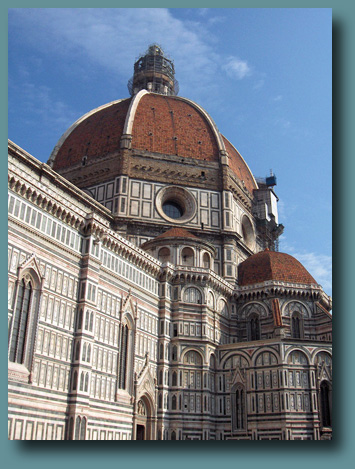
Dome of
Basilica di
Santa Maria del Fiore, Florence, Italy
|
Characteristics
|
Humansim
Renaissance scholars employed the humanist method in study, and searched
for realism and human emotion in art. Humanism was not a philosophy
per se, but rather a method of learning. In contrast to the medieval
scholastic method, which focused on resolving contradictions between
authors, humanists would study ancient texts in the original, typically
written in Latin or ancient Greek, and appraise them through a combination
of reasoning and empirical evidence. Scholars scoured Europe's monastic
libraries, searching for works of classical antiquity which had fallen
into obscurity. One such hunt by Poggio Bracciolini, who was credited with
the discovery of the complete works of fifteen different authors, turned
up Vitruvius' work on art and architecture, allowing for the completion of
the Duomo of Florence by Filippo Brunelleschi. In such texts they found a
desire to improve and perfect their worldly knowledge; an entirely
different sentiment to the spirituality stressed by
medieval Christianity. Humanist education was based on the study of
poetry, grammar, ethics and rhetoric. Above all, humanists asserted "the
genius of man; the unique and extraordinary ability of the human mind." They did not reject Christianity; quite the
contrary, many of the Renaissance's greatest works were devoted to it, and
the Church patronized many works of Renaissance art. However, a subtle
shift took place in the way that intellectuals approached religion that
was reflected in many other areas of cultural life. |
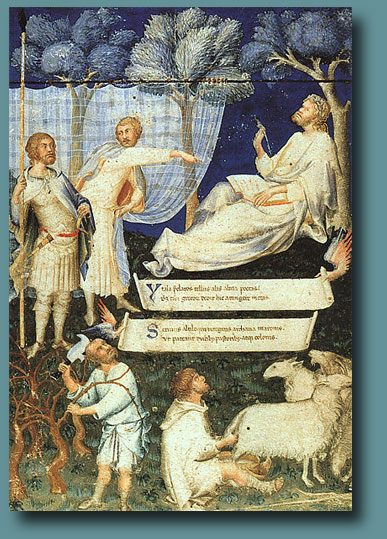
Title page of "Petrarch's Virgil" (c. 1336)
Illuminated manuscript by Simone Martini |
 |
Artists such as
Masaccio strove to portray the human form realistically,
developing techniques to render perspective and light more naturally.
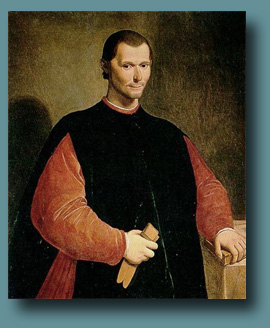
Political philosophers, most famously
Niccolò Machiavelli, sought to
describe political life as it really was, and to improve government on the
basis of reason. In addition to studying classical Latin and Greek,
authors also began increasingly to use vernacular languages; combined with
the invention of printing, this would allow many more people access to
books, especially the Bible. In all, the Renaissance could be viewed as an
attempt by intellectuals to study and improve the secular and worldly,
both through the revival of ideas from antiquity, and through novel
approaches to thought.
Niccolò Machiavelli,
Philosopher |
Art
 |
|
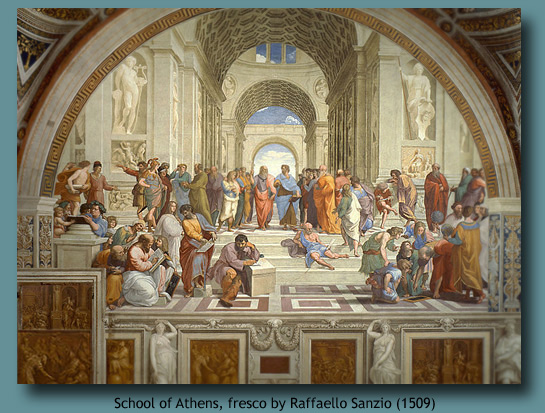
Raphael originally
sketched this painting without the figure leaning on the block at the
foot of the stairs towards the left. As a tribute to his rival,
Raphael added him to his final work.
He is Michelangelo. |
One of the distinguishing features of
Renaissance art was its development of highly realistic linear perspective.
Giotto di
Bondone (1267–1337) is credited with first treating a painting as
a window into space, but it was not until the demonstrations of architect
Filippo
Brunelleschi (1377–1446) and the later writings of Leon
Battista
Alberti (1404–1472) that perspective was formalized as an artistic
technique. The development of perspective was part of a wider trend towards
realism in the arts. To that end, painters also developed other techniques,
studying light, shadow, and, famously in the case of Leonardo da Vinci,
human anatomy. Underlying these changes in artistic method was a renewed
desire to depict the beauty of nature, and to unravel the axioms of
aesthetics, with the works of Leonardo, Michelangelo and
Raphael representing artistic pinnacles that were to be much imitated by other
artists. Other notable artists include
Sandro Botticelli, working for the
Medici in Florence,
Donatello another Florentine
and Titian in Venice. |
 |
|
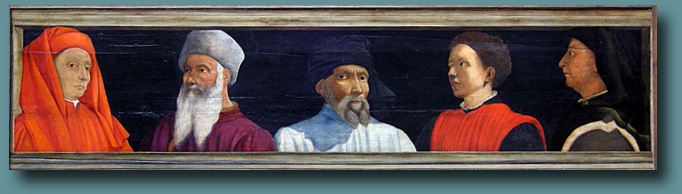
Five Masters of the
Florentine Renaissance, Louvre Museum, Paris, France
This 210cm x 42cm Wooden panel, much repainted, was originally thought to
be by Paolo Uccello (1397 - 1475), but now the consensus is that it was
painted a bit later. The consensus is also that the faces do not all match
the names inscribed underneath them by some helpful soul some time after
the painting was done. The true identities are thought to be (left to
right)
Antonio Manetti - Brunelleschi's biographer and
mathematician friend of Uccello (artist and perspective freak),
Donatello,
Paolo Uccello himself, Tommaso Masaccio, and
Filippo Brunelleschi. |
The upheavals occurring in the arts and
humanities were mirrored by a dynamic period of change in the sciences.
The Renaissance saw significant changes in the way the universe was viewed
and the methods with which philosophers sought to explain natural
phenomena.
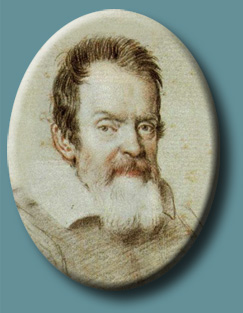
Galileo
Galilei
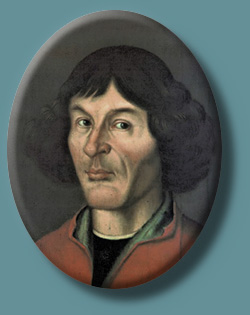
Science and art were very much intermingled in the
early Renaissance, with artists such as
Leonardo da Vinci making observational drawings of anatomy and nature. Yet
the most significant development of the era was not a specific discovery,
but rather a process for discovery, the scientific method. This
revolutionary new way of learning about the world focused on empirical
evidence, the importance of mathematics, and discarding the
Aristotelian
"final cause" in favor of a mechanical philosophy. Early and influential
proponents of these ideas included Copernicus and Galileo. The new
scientific method led to great contributions in the fields of astronomy,
physics, biology, and anatomy.
Nicolaus
Copernicus |
Music
|
Early Renaissance music (1400 – 1467) gradually dropped the late
Medieval period's complex devices of
isorhythm and extreme
syncopation,
resulting in a more flowing style. What the music "lost" in rhythmic
complexity, it gained in rhythmic vitality, as a "drive to the cadence"
became a prominent feature around mid-century.
In the early 1470s, music starts to be printed
using a printing press. Music printing had a major effect on how music
spread for not only did a printed piece of music reach a larger audience
than any manuscript ever could, it did it far cheaper as well. Also
during this century, a tradition of famous makers began for many
instruments. These makers were masters of their craft. An example is
Neuschel for his trumpets. Towards the end of the 15th century,
polyphonic sacred music had once again become more complex, in a
manner that can perhaps be seen as correlating to the stunning detail in
the painting at the time.
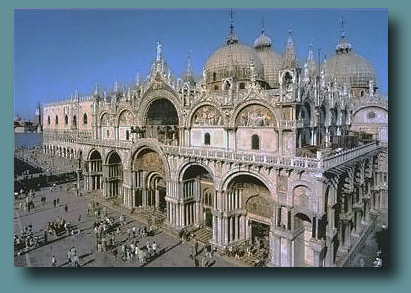
In Venice, from about 1534 until around 1600,
an impressive poly-choral style developed, which gave Europe some of the
grandest, most sonorous music composed up until that time, with multiple
choirs of singers, brass and strings in different spatial locations in
the
Basilica San Marco di Venezia
(St. Mark's Basilica). These multiple
revolutions spread over Europe in the next several decades, beginning in
Germany and then moving to Spain, France and England somewhat later,
marking the beginning of what we now know as the
Baroque musical
era.
The Roman School was a group of composers of
predominantly church music in Rome, spanning the late Renaissance and
early Baroque eras. Many of the composers had a direct connection to the
Vatican and the papal chapel, though they worked at several churches;
stylistically they are often contrasted with the Venetian School of
composers, a concurrent movement which was much more progressive. By far
the most famous composer of the Roman School is
Giovanni Pierluigi da
Palestrina, whose name has been associated for four hundred years with
smooth, clear, polyphonic perfection.
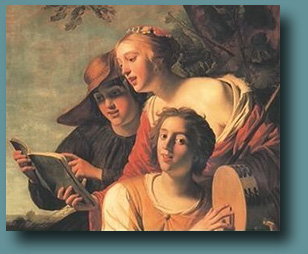 The brief but intense flowering of the musical
madrigal in England, mostly from 1588 to 1627, along with the composers
who produced them, is known as the English Madrigal School. The English
madrigals were
a cappella, predominantly light in style, and generally
began as either copies or direct translations of Italian models. Most
were for three to six voices. Musica reservata is either a style or a
performance practice in a cappella vocal music of the latter, mainly in
Italy and southern Germany, involving refinement, exclusivity, and
intense emotional expression of sung text. In addition, many composers
observed a division in their own works between a prima pratica (music in
the Renaissance polyphonic style) and a seconda pratica (music in the
new style) during the first part of the 17th century. The brief but intense flowering of the musical
madrigal in England, mostly from 1588 to 1627, along with the composers
who produced them, is known as the English Madrigal School. The English
madrigals were
a cappella, predominantly light in style, and generally
began as either copies or direct translations of Italian models. Most
were for three to six voices. Musica reservata is either a style or a
performance practice in a cappella vocal music of the latter, mainly in
Italy and southern Germany, involving refinement, exclusivity, and
intense emotional expression of sung text. In addition, many composers
observed a division in their own works between a prima pratica (music in
the Renaissance polyphonic style) and a seconda pratica (music in the
new style) during the first part of the 17th century.
Instruments of the Renaissance
Many instruments originated during the
Renaissance; others were variations of, or improvements upon
instruments that had existed previously. Some have survived to
the
present day; others have disappeared, only to be recreated in
order to perform music of the period on authentic instruments.
As in the modern day, instruments may be classified as brass,
strings, percussion, and woodwind.
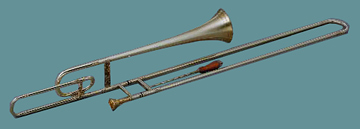 Brass instruments in the
Renaissance were traditionally played by professionals. Some of
the more common brass instruments that were played:
Slide trumpet
Cornett
Trumpet
Sackbut
(Image at right) Brass instruments in the
Renaissance were traditionally played by professionals. Some of
the more common brass instruments that were played:
Slide trumpet
Cornett
Trumpet
Sackbut
(Image at right)
Strings
were used in many circumstances, both sacred and secular. A few
members of this family include:
Viol
Lyre
Irish
Harp
Hurdy Gurdy
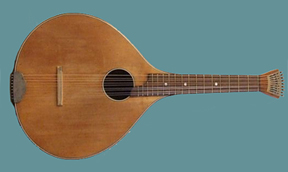
Cittern
(below)
Lute
Harpsichord
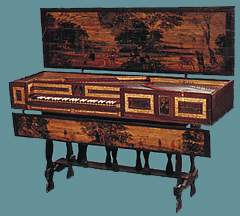
Virginal
(at right)
Percussion Some Renaissance
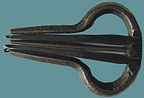
percussion instruments include the triangle, the Jew's harp, the
tambourine, the bells, the rumble-pot, and various kinds of
drums.
Tambourine
Jew's harp
(image at right)
Woodwinds (Aerophones) The woodwind
instruments (Aerophones) use a column of air vibrating within a
pipe that has little holes along it to generate vibration with
the airflow through the pipe and control the length of the sound
waves produced by the vibrating air. A player could create this
air column by using a few different
 methods. The first is
blowing across a mouth hole (as would be done with flutes). The
second is blowing into a mouthpiece with a single reed (as would
be found with the clarinet or saxophone) or a double reed (which
is used with oboes and bassoons). methods. The first is
blowing across a mouth hole (as would be done with flutes). The
second is blowing into a mouthpiece with a single reed (as would
be found with the clarinet or saxophone) or a double reed (which
is used with oboes and bassoons).
The woodwind instruments of the Middle
Ages are not the same as modern day woodwinds. They were more
eccentric and exotic. For example, you would find that modern
woodwinds fit the natural position of the hand. Woodwinds in the
Renaissance used simple holes drilled in the instrument.
Reed pipe
Hornpipe
Bagpipe
Panpipe
Transverse flute
Recorder
Shawm (Image
at right)
Information for this
page comes from Wikipedia |
|